
Mitakon Speedmaster 50mm f/0.95 review for Canon EF
The Mitakon Speedmaster 50mm f/0.95 for Canon EF is not a normal fifty. It is a heavy, fully manual, ultra-fast full-frame lens built for photographers who want extreme subject separation, very low-light shooting and a distinctive optical character.
This Canon EF version is especially interesting because it brings the f/0.95 look to DSLR shooters and to mirrorless users who adapt EF lenses. It is also a lens with serious compromises: weight, manual focus and a depth of field so thin that small focusing errors are immediately visible.
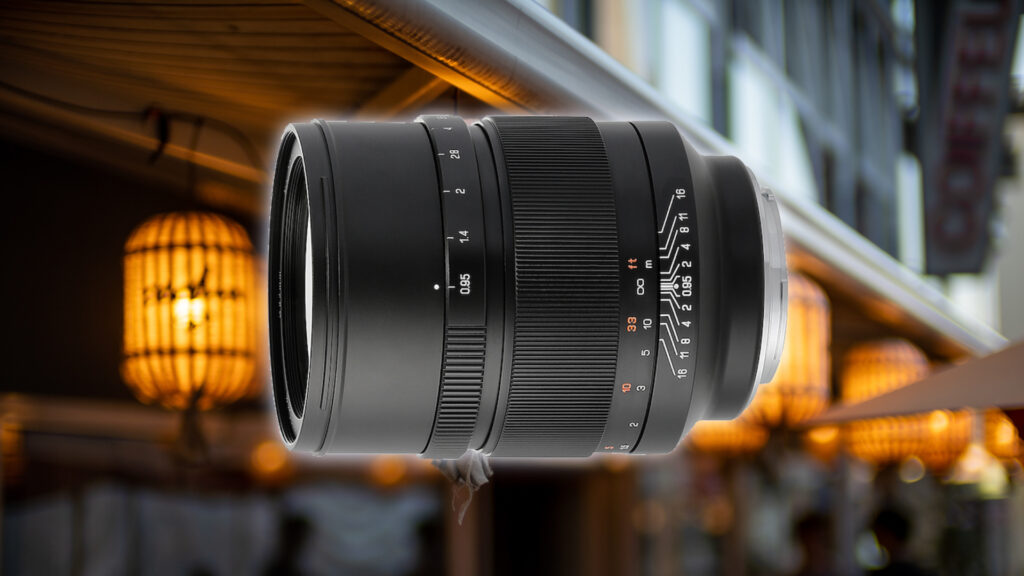
Mitakon Speedmaster 50mm f/0.95 Canon EF specifications
| Specification | Detail | Practical meaning |
|---|---|---|
| Mount | Canon EF | Works on Canon DSLR bodies and adapts well to mirrorless |
| Format | Full frame | Classic 50mm angle of view on full-frame cameras |
| Maximum aperture | f/0.95 | Extreme subject separation and very low-light capability |
| Minimum aperture | f/16 | More depth of field for controlled work |
| Focus | Manual focus only | Requires patience, magnification and repeated practice |
| Image stabilization | No | Use shutter speed, tripod or stabilized mirrorless body when possible |
| Optical construction | 12 elements in 6 groups | Large, complex DSLR optical design |
| Aperture blades | 11 | Smoother out-of-focus highlights |
| Minimum focus distance | 0.65m | Good for portraits, not close-focus detail work |
| Filter thread | 82mm | Filters are larger and more expensive |
| Weight | About 1.5kg | Better on larger bodies or controlled shoots |
Build quality and handling
The first thing you notice is the weight. At around 1.5kg, this is a dense lens that feels better on larger Canon bodies than on small, lightweight setups. The all-metal construction and large glass elements give it a serious, almost cinema-lens feel, but they also make it tiring for long handheld walks.
The 82mm filter thread is another sign that this is not a small casual prime. If you shoot video, neutral-density filters become important because f/0.95 lets in a huge amount of light. For stills, the large aperture is the reason to use the lens, but it also forces more careful technique.
Manual focus at f/0.95
This lens has no autofocus. At f/0.95, focusing is the whole challenge. The depth of field can be extremely thin, especially at close portrait distances. On DSLR bodies, live view magnification helps. On mirrorless bodies with an EF adapter, focus peaking and magnified view make the experience much easier.
- Use magnified live view whenever the subject is static.
- Focus on the nearest eye for portraits.
- Take several frames when shooting wide open.
- Stop down to f/1.4 or f/2 when you need more reliability.
- Use a tripod for still life, product work or controlled scenes.
- Check focus after the first few frames before committing to a whole set.
Best settings for real shoots
| Use case | Aperture | Technique | Why |
|---|---|---|---|
| Dreamy portrait | f/0.95 to f/1.2 | Magnify on the near eye | Uses the signature shallow-depth look |
| Safer portrait | f/1.4 to f/2 | Take short bursts and review focus | More keeper rate with strong blur |
| Low-light scene | f/0.95 to f/2 | Use a stable stance or tripod | Balances atmosphere and sharpness |
| Video detail | f/1.4 to f/2.8 | Use ND filters in daylight | Keeps exposure under control |
| Still life | f/2.8 to f/5.6 | Tripod and manual focus magnification | Gives enough depth for objects |
Using the Canon EF version on mirrorless
The EF mount version can be attractive if you use both Canon DSLR and mirrorless bodies, or if you already own an EF adapter. On Canon EOS R cameras, a good EF-RF adapter keeps the lens usable while focus peaking and magnification make manual focusing much less frustrating than through an optical viewfinder.
On mirrorless systems, the weight still matters. The lens can become front-heavy, so it works better for deliberate portraits, video shots and controlled scenes than for casual travel photography.
Image quality and character
The Mitakon Speedmaster 50mm f/0.95 is about rendering more than clinical perfection. Wide open, it can produce a dreamy look with strong background separation and visible falloff. That makes it powerful for portraits, music videos, editorial details and low-light scenes where atmosphere matters more than edge-to-edge sharpness.
Do not expect it to behave like a modern autofocus 50mm f/1.2 from Canon or Nikon. It is softer and more difficult wide open, and it needs careful handling. Stopped down, it becomes more controlled, but the main reason to buy it is still the f/0.95 look.
Who should buy it?
- Good fit: portrait photographers, video creators, fine-art work, low-light scenes and photographers who enjoy manual focus.
- Not ideal: weddings, fast events, sports, travel kits or anyone who needs reliable autofocus.
- Best use: controlled shoots where the ultra-shallow depth of field adds emotion instead of becoming a distraction.
Used buying checklist
- Check the focus ring for smooth movement and no grinding.
- Inspect the aperture blades and confirm they move evenly.
- Look carefully for haze, fungus or internal dust in the large glass elements.
- Test wide-open focus on a real subject, not only a shelf or wall.
- Confirm the EF mount is not loose and that the lens adapts securely to your camera.
- Budget for an 82mm ND filter if you plan to shoot video at wide apertures.
Pros and cons
| Pros | Cons |
|---|---|
| Extremely bright f/0.95 aperture | Very heavy for a 50mm lens |
| Strong subject separation | Manual focus only |
| Distinctive portrait and video rendering | No stabilization or electronic convenience |
| Full-frame Canon EF compatibility | Requires practice to use well wide open |
| Useful on mirrorless with focus peaking | Large 82mm filters increase accessory cost |
Verdict
The Mitakon Speedmaster 50mm f/0.95 for Canon EF is a specialist lens. It is heavy, manual and unforgiving, but it can create images with a look that ordinary 50mm lenses do not easily match. If you want precision and speed, choose a modern autofocus prime. If you want a slower, more cinematic and character-driven experience, this Mitakon is genuinely interesting.
For a more practical normal-lens comparison, read my guide to choosing a 50mm prime lens. You can also compare this approach with the TTArtisan 50mm f/1.2 APS-C review and the Nikon Z 40mm F2 review.
